The Ultimate Gymnastics Parent Vocabulary Guide
Common Terms Every New Gymnastics Parent Should Know
Lost in Gymnastics Conversations? You're Not Alone.
Have you ever sat in the gym lobby and overheard parents saying things like:
"She got her kip!"
"They're hoping to mobility to Level 6."
"She qualified for regionals with a 36.5 all-around."
And found yourself smiling and nodding while secretly wondering what any of it meant?
If so, welcome to the club.
Gymnastics has its own language, and for new parents it can feel overwhelming at first.
The good news is that you'll pick it up quickly. To help you get started, we've put together this guide to some of the most common gymnastics terms you'll hear throughout your athlete's journey.
A
All-Around (AA)
The total score a gymnast receives by adding together her scores from all four events:
Vault
Uneven Bars
Balance Beam
Floor Exercise
Example: Vault: 9.2 + Bars: 9.1 + Beam: 9.0 + Floor: 9.3 = All-Around: 36.6
Artistry
The quality of movement, presentation, rhythm, confidence, and performance during a routine, especially on beam and floor.
B
Back Handspring (BHS)
One of the most common gymnastics skills where the gymnast jumps backward onto her hands and pushes back to her feet.
You'll hear this term a lot!
Balance Beam
A 4-inch-wide apparatus where gymnasts perform dance skills, jumps, turns, acrobatics, and dismounts.
Many parents consider beam the most nerve-wracking event to watch.
Bonus
Additional difficulty credit awarded in optional gymnastics when certain skills or skill connections are performed.
C
Cast
A bars skill where the gymnast pushes away from the bar while maintaining body tension.
Casts are fundamental to higher-level bars development.
Compulsory Gymnastics
Levels where athletes perform predetermined routines.
In USAG, compulsory levels include:
Level 1
Level 2
Level 3
Level 4
Level 5
Every gymnast performs essentially the same routine.
Connection
When two skills are performed directly together without pauses.
Connections often earn bonus points at higher levels.
D
Deduction
Points taken away by judges for mistakes.
Common deductions include:
Bent knees
Flexed feet
Balance checks
Steps on landings
Falls
Dismount
The skill used to exit an apparatus.
Every event ends with a dismount.
E
Execution Score
A gymnast's score after deductions have been taken for form, technique, and performance errors.
Event Finals
A competition format where gymnasts qualify to compete on individual events.
More common in elite gymnastics than developmental gymnastics.
F
Fall
When a gymnast comes off the apparatus or lands on the floor unexpectedly.
In many competitive programs, a fall results in a 0.50 deduction.
Floor Exercise
The event where gymnasts perform tumbling, dance, leaps, jumps, and choreography to music.
G
Giant
A full circle around the bar in a handstand position.
Often considered a major milestone in a gymnast's development.
Grip
Leather hand guards worn on bars to help protect hands and improve grip.
H
Handstand
One of the most important foundational skills in gymnastics.
Many advanced skills begin or pass through a handstand position.
I
Invitational
A gymnastics competition hosted by a gym that invites teams from other gyms to attend.
Most regular-season meets are invitationals.
J
Judge
The official responsible for evaluating routines and assigning scores.
Judges evaluate:
Technique
Form
Execution
Artistry
Difficulty
K
Kip
One of the most important bars skills.
A kip allows a gymnast to move from hanging below the bar into front support on top of the bar.
Parents often celebrate a gymnast's first kip almost as much as moving up a level!
L
Level
A gymnast's competitive classification based on skill development and requirements.
Examples include:
Level 2
Level 5
Level 8
Level 10
Leap
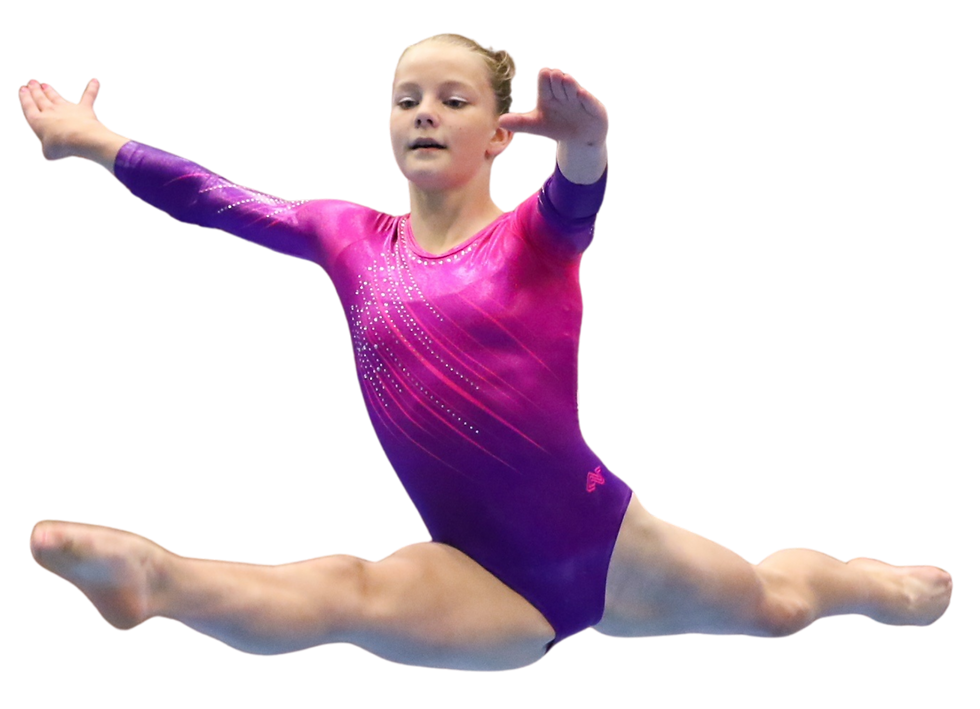
A dance element where the gymnast jumps from one foot to the other while achieving split positions in the air.
M
Mobility Score
The score required to advance from one level to the next.
Requirements vary by organization and program.
Meet
A gymnastics competition.
Think of a meet as gymnastics' version of a game or tournament.
O
Optional Gymnastics
Levels where gymnasts perform personalized routines.
In USAG, optional levels include:
Level 6
Level 7
Level 8
Level 9
Level 10
P
Perfect 10
The highest possible score under the traditional scoring system.
Perfect 10s are rare and exciting moments.
Pre-Team
A developmental training group that prepares athletes for future competitive team participation.
Q
Qualifying Score
A score needed to advance to State, Regional, or National competitions.
R
Routine
A complete performance on an event.
Regionals
A championship competition beyond the State Championship level.
Not all gymnasts qualify for Regionals.
S
Salute
The gesture gymnasts make before and after a routine to acknowledge the judges.
Scratch
When a gymnast does not compete an event or withdraws from competition.
Stick
Gymnastics slang for landing without taking a step.
Few things excite a crowd more than a stuck landing!
T
Team Score
A score calculated using multiple gymnasts' performances to determine team rankings.
Tumble Pass
A connected series of tumbling skills performed on floor exercise.
U
Uneven Bars
The event consisting of a high bar and a low bar where gymnasts swing, circle, release, and transition between bars.
V
Vault
The event where gymnasts sprint down a runway, hit a springboard, contact the vault table, and perform an aerial skill.
The fastest event in gymnastics!
W
Warm-Up
Designated practice time before competition begins.
Gymnasts use warm-ups to prepare mentally and physically for their routines.
X
Xcel Program
A popular competitive gymnastics program designed to provide flexibility and opportunities for athletes at various skill levels.
Xcel divisions include:
Bronze
Silver
Gold
Platinum
Diamond
Sapphire
Y
Yurchenko
A family of advanced vaults that begins with a round-off onto the springboard.
One of the most common vault families in optional and elite gymnastics.
Z
Zone
A mental state where athletes are fully focused and performing at their best.
Every gymnast hopes to compete "in the zone."
Final Thoughts
Learning gymnastics terminology can feel overwhelming at first, but don't worry—every experienced gymnastics parent started exactly where you are now.
Before long, you'll find yourself discussing kips, mobility scores, and beam series with confidence.
And remember, there are no silly questions in gymnastics. The sport is incredibly complex, and learning the language is simply part of the journey.
The more you understand the terminology, the more you'll be able to appreciate the hard work, dedication, and skill that your gymnast brings to the sport every day.


Comments